



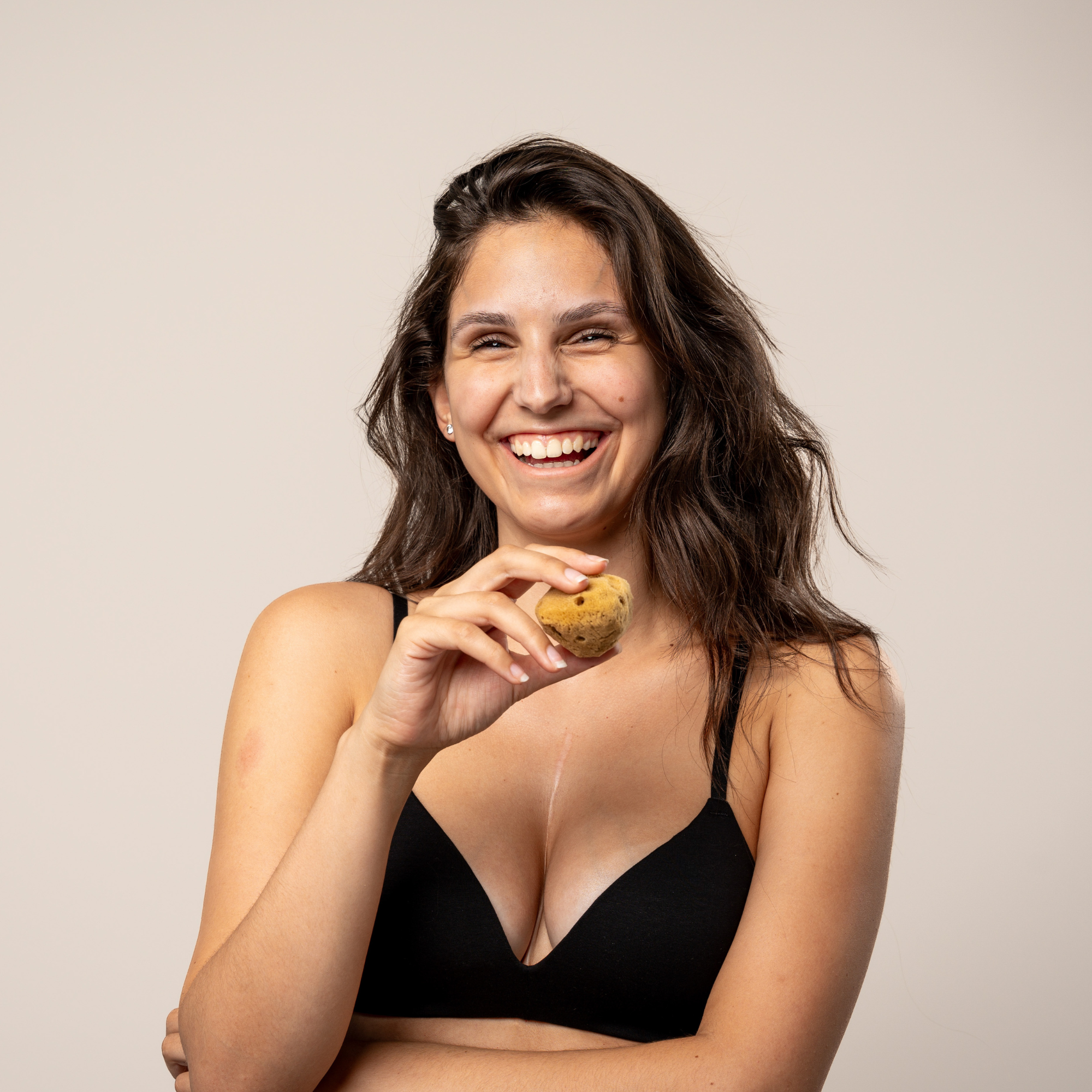
Endometriosis and severe pain: Why Lea switched to the menstrual sponge
Severe pain. Three days a month out of action. And yet, for a long time, the feeling that this was normal.
Lea was 22 when she was diagnosed with endometriosis. Today, she says that besides the diagnosis itself, a change in her period routine also brought about significant improvements for her.
Lea wrote to us and told us about her endometriosis. And about how the menstrual sponge feels for her. Her story deeply touched us.
We found her insights so valuable that we asked her if we could share her experiences. Because perhaps this report will help you if you yourself live with endometriosis. Perhaps it will encourage you to try new approaches.
Facts for those in a hurry
• Diagnosis at 22 after years of severe pain
• Tampons and cups increased pressure sensation
• Soft sponge without vacuum felt more comfortable
• Lea experienced less pressure and discomfort as a result
• Rinsing became a conscious body routine
• Understanding the body better changes how symptoms are managed
How was endometriosis diagnosed?
For many years, Lea experienced severe pain during her period. Nevertheless, for a long time, she assumed that this was "just part of it." It wasn't until she was 22 that she decided to actively seek answers.
"I presented myself at an endometriosis center at my own request," she recounts. After an examination, she received the diagnosis in 2022.
The diagnosis wasn't a shock. More of an explanation.
Finally, what she experienced every month had a name.
Especially with endometriosis, many affected individuals report similar experiences. Pain is normalized. And it often takes years to get a diagnosis.
How did her menstruation feel before the endometriosis diagnosis?
Even as a young woman, Lea experienced severe pain during her menstruation. "I was often incapacitated for three or more days per month," she recounts. For her, the pain was simply part of it, and she considered it "normal."
Looking back, she says that she didn't question her symptoms for a long time. Her period was something you just endure. Added to this was a feeling of shame. Menstruation was not openly discussed.
It was much later that she realized: severe, debilitating pain is not a condition that one simply has to accept.
When is period pain no longer normal?
If pain, like Lea's back then, regularly restricts you in everyday life, painkillers hardly help, or you are incapacitated for several days, you should have your symptoms checked by a doctor. Because severe pain is not a condition that you simply have to accept.
The following symptoms are also important to take seriously:
-
very heavy or unusually long bleeding
-
foul-smelling discharge
-
pain during bowel movements or sex
-
severe back pain
-
nausea or circulatory problems
-
pain radiating into the legs or back
In such cases, endometriosis or another physical cause may be present. The sooner you have it checked, the better you can get targeted support.
Tip: Keep a cycle diary. Note when you have which symptoms, how severe they are, and how you feel. This not only helps you but also your doctor.
Why can tampons and menstrual cups be difficult with endometriosis?
During her menstruation, Lea initially used tampons as a matter of course. They were discreet, easy to change, and uncomplicated in everyday life. "I found them okay and practical," she says.
She didn't like pads, however. She found the feel and smell unpleasant.
Later, she tried a menstrual cup. But here, she clearly noticed that something didn't feel right. "I felt stronger pain and this vacuum, as well as a strong sensation of a foreign body."
Especially with endometriosis, additional pressure in the pelvic area can be perceived as uncomfortable. For Lea, it was clear: she wanted an alternative that was softer and did not create negative pressure.
How did the menstrual sponge come into play?
After her experience with the menstrual cup, Lea looked for a gentler alternative. The menstrual cup had caused Lea pressure. She no longer wanted this feeling. So she started looking for another option.
When she came across menstrual sponges, she was curious. "The soft material immediately appealed to me," she says. The idea of using something natural felt right to her.
The aspect of sustainability also played a role. Less waste. A more conscious approach to one's own body.
It wasn't a big decision. More like a quiet feeling of: This could fit.
👉 Click here for the HERA online shop for menstrual sponges
What felt new when she first tried the sponge?
Lea says that rinsing was new to her at first. "It took some getting used to at the beginning," she says. Over time, however, she got really used to it.
Instead of finding it unpleasant, she began to perceive her menstruation more consciously. Amount, color, consistency. Things that used to happen more incidentally.
For her, this was a step towards a more natural approach to her body.
Perhaps that's precisely an important point: menstrual blood is not disgusting. It is a natural part of the body. If this view changes in society, then dealing with it can also become much more conscious and natural.
In what way can the menstrual sponge help with endometriosis?
For Lea, the biggest difference lies in the wearing comfort. The sponge does not exert firm pressure and does not create negative pressure. This is precisely what she found uncomfortable about the menstrual cup.
"Since I started using the sponge, I feel better faster after my period," she says. She doesn't describe it as a miracle. But as a noticeable relief in everyday life.
What is important to her: the sponge does not treat endometriosis. But for her, this form of support during her period feels gentler and she feels better overall.
Tip: Many women find menstrual sponges particularly gentle. They adapt to the body without pressing or drying out – an advantage if you don't feel well or have pain during your period.
How does the menstrual sponge feel compared to other products?
For Lea, the sponge feels more natural and inconspicuous than tampons or cups. Compared to before, Lea describes the wearing comfort as significantly softer. No rigid material. No pressure. No noticeable vacuum.
"It feels much more natural," she says. So much so that she sometimes almost forgets about her menstruation in everyday life.
Especially with endometriosis, when the body reacts sensitively anyway, this reduced foreign body sensation can make a difference.
How has the switch to the menstrual sponge affected her body and cycle?
By switching, Lea engaged more intensely with her cycle. She learned to perceive her body more consciously.
Lea says that not everything changed just because of the sponge. But it was an important impulse.
She began to look more closely. When does her period announce itself? How does her body change during her cycle? Which days are particularly sensitive?
The topic of preparation also played a role. Instead of buying tampons in an emergency, she knew: My period is coming soon. I'm taking my sponges with me. This conscious foresight brought her closer to her own rhythm.
"It showed me that pain can lessen," she says. And that it's worth engaging with your own body.
What does she want to share with other women with endometriosis?
Lea advises those affected to remain open and try new things. The menstrual sponge can be a gentle alternative for pressure sensitivity or sensitive mucous membranes.
"I would say: try it," she says. Especially if tampons or the cup feel uncomfortable, the sponge can provide a different experience.
And that, for Lea, is the crucial point: to deal with one's own illness.
Endometriosis is complex. No one is to blame for it. And no one "causes" it through wrong behavior. She explicitly emphasizes this.
What she has learned, however, is that when you start to understand your own body better, observe your own patterns, and take them seriously, your approach to symptoms changes.
For her, this did not mean forgoing medical care. But rather, to look additionally. What is good for me? What exacerbates symptoms? What feels right?
Conventional methods can be important and necessary. At the same time, for some affected individuals, it is not enough to simply suppress symptoms. Taking one's own body feelings seriously can be an additional step.
For Lea, that was exactly the turning point: not to work against her body, but with it, and the menstrual sponge helped her with that. 
FAQs
Can a menstrual sponge cure endometriosis?
No. A menstrual sponge is not a medical therapeutic procedure and does not replace medical treatment. However, it can be a more comfortable alternative to tampons or cups for those affected.
Is the menstrual sponge safe for endometriosis?
Generally yes, if used correctly and cleaned regularly. It is important to maintain hygiene and consult a gynecological specialist if you have any doubts.
Can the sponge reduce pain?
It does not treat endometriosis. However, some users report that the softer material and lack of vacuum cause less pressure sensation for them.
Can the sponge get lost in the body?
No. The vagina is anatomically limited. The sponge cannot "disappear" into the body. It can be easily removed with a retrieval string or two fingers.
Who is the menstrual sponge particularly suitable for?
Especially for women who find rigid products or vacuum uncomfortable. It can also be an alternative for sensitive mucous membranes or pressure sensitivity.
How long does a menstrual sponge last?
With good care, a sponge will last you 4 to 6 months. After that, it can be composted or disposed of in organic waste.
How do I find the right menstrual product for pain?
Choose a product that is soft, flexible, and comfortable to wear – especially if your abdomen is sensitive. Many find menstrual sponges comfortable because they adapt to the body and are barely noticeable.
Read more

With the menstrual sponge, you can manage your period naturally and stress-free, even on the go. It's soft, absorbent, and adapts to your body – without creating waste or drying out. With a fresh...

The personal story behind the founding of HERA Organics: How my own cycle complaints and the search for a better solution led to the menstrual sponge entering my life. Why I questioned conventional...
