


Period waste: How much trash you actually save with a menstrual sponge
Every month, most women throw away a whole pile of tampons and pads. Over a lifetime, this adds up to much more than you would think, and very little of it ever decomposes. We calculate how much menstrual waste conventional products actually cause and how much you can save with a period sponge.
Facts for those in a hurry
-
A woman uses around 10,000 to 17,000 tampons and pads in her lifetime.
-
In Germany, Austria, and Switzerland, this amounts to 75,000 to 125,000 tons of waste annually—the weight of twelve Eiffel Towers.
-
Around 87% of disposable period products in Europe end up in landfills, where the plastic takes up to 500 years to decompose.
-
Period products are among the most common items found during beach cleanups.
-
Around 250 disposable products a year are replaced by 6 to 12 natural sponges.
-
The period sponge is a 100% natural product with no plastic content and can be disposed of in organic waste or on the compost, where it decomposes without leaving any residue.
-
It is harvested by hand in controlled marine zones in Greece, only from June to September, so that the stocks can recover for the remaining eight months.
Sources: BUND Baden-Württemberg, UNEP Life Cycle Initiative, 2021
How much period waste do tampons and pads really cause?
A woman menstruates on average twelve times a year, for about six days each time. At three to four products per day, that is around 250 tampons or pads per year—not even including panty liners in between. Over a period-active life of around 40 years, this results in about 10,000 individual products.
Converted into weight: a tampon weighs about four grams, a pad about ten. That makes 1 to 2.5 kilograms of pure product waste per year, plus applicators, individual packaging, and cardboard boxes on top of that.
Over an entire lifetime, this amounts to 40 to 100 kilograms; including applicators, it can even reach around 150 kilograms per person.
For all menstruating people in Germany, Austria, and Switzerland combined, estimates suggest 75,000 to 125,000 tons annually. For comparison: the Eiffel Tower weighs about 10,000 tons. So we are talking about twelve Eiffel Towers made of tampons and pads every year. In just three countries.
Where this waste actually ends up
The most common thought is: "It just goes in the trash, gets burned, and that's it." It's not that simple—there are three paths, and none of them are good.
To the landfill. It is estimated that around 87% of disposable period products in Europe end up in landfills. There, the plastic components take up to 500 years to decompose. So, a tampon from today will outlast about twenty generations.
To incineration. What is burned is not gone, but converted: into emissions and residues. Plastics burn because they are made of crude oil, with the corresponding climate impact.
Into the toilet. The path that is talked about the least. A tampon is designed to absorb liquid and retain its shape; that is exactly what makes it a problem in a sewer pipe. It swells up, gets stuck, collects grease and hair, and becomes a plug. Whatever gets through ends up in the sewage treatment plant or, if it is overloaded, in the water. At the end of this chain are the beaches: period products are among the most common items found during beach cleanups in Europe.
How much waste do you save with a period sponge?
Instead of around 250 disposable products per year, you need an average of 6 to 12 natural sponges. We recommend using one sponge for up to 6 cycles, depending on your flow.
Calculated over 40 years, that comes to about 240 to 480 compostable sponges instead of around 10,000 disposable products.
You will notice yourself when a sponge has reached the end of its life: it becomes brittle, absorbs noticeably less, or permanently changes color. Then it goes into the organic waste or onto the compost. The sponge decomposes completely on the compost within a few months, with no residue and no waste.
Four layers of packaging for just eight hours of use
The real insanity only becomes visible when you trace the entire journey of a single tampon.
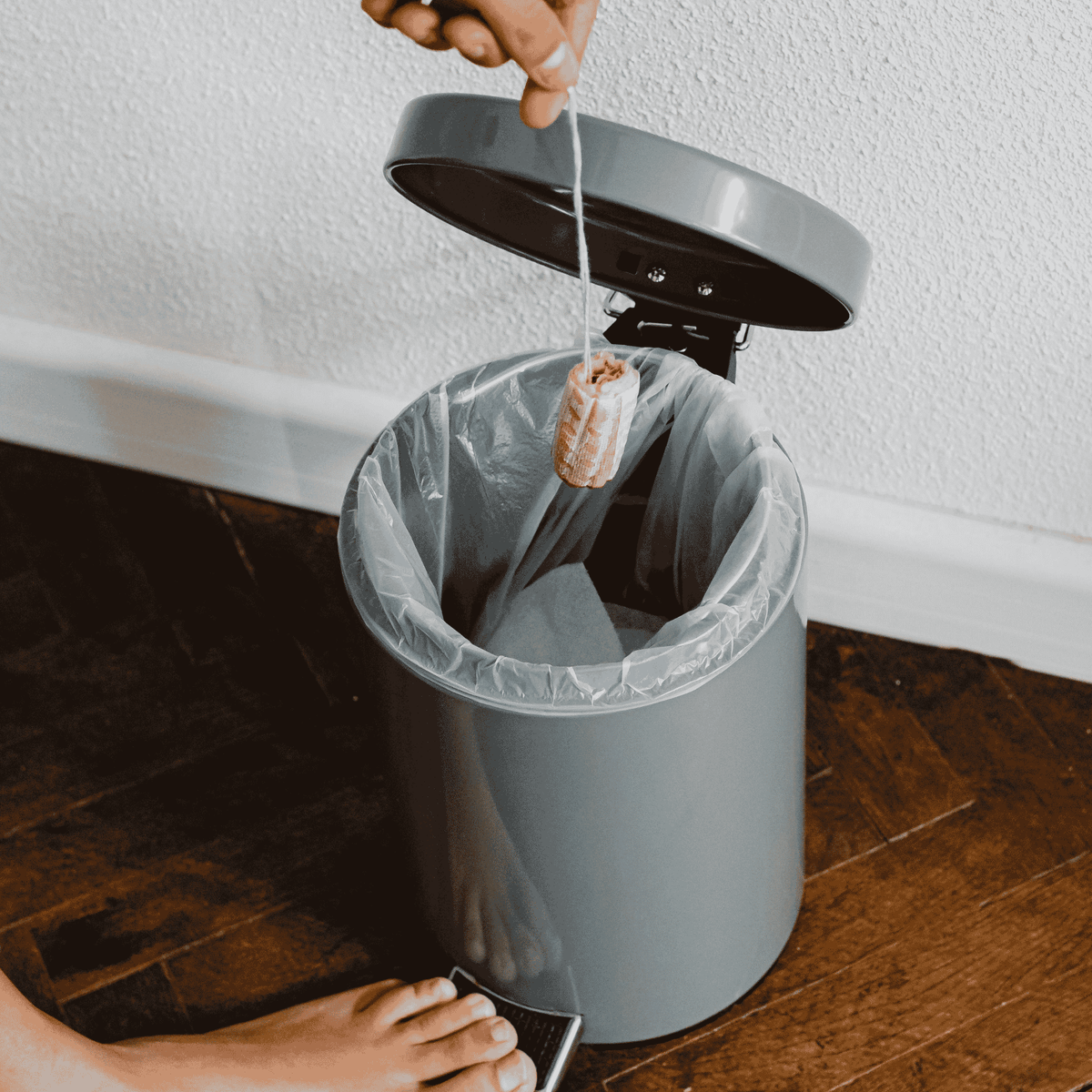
The tampon itself contains plastic: in the retrieval string, in the fleece cover, and in the applicator. It is individually wrapped in film. After use, it goes into a hygiene bag, also made of plastic. And that then migrates into the trash bag. Also plastic.
Four layers of packaging for a product that was in use for eight hours. Plus a waste bin in the bathroom that needs to be emptied after every period, and the regular purchasing of bags, liners, and the products themselves.
With the period sponge, the cycle looks like this: use, rinse, use again. After your period, soak for 20 minutes with a cleaning tablet, let dry. After a few cycles, compost it.
No hygiene bag. No smelly trash bin. And no searching for a trash can in a public restroom.
A common myth: "Isn't that like a coral?"
We get this question quite often, and it is a valid one because hardly anyone knows what a natural sponge actually is.
No, it is not a coral. And no, it is not a plant either. A sponge is an organism, one of the oldest in existence, but without a nervous system or brain and without a circulatory system.
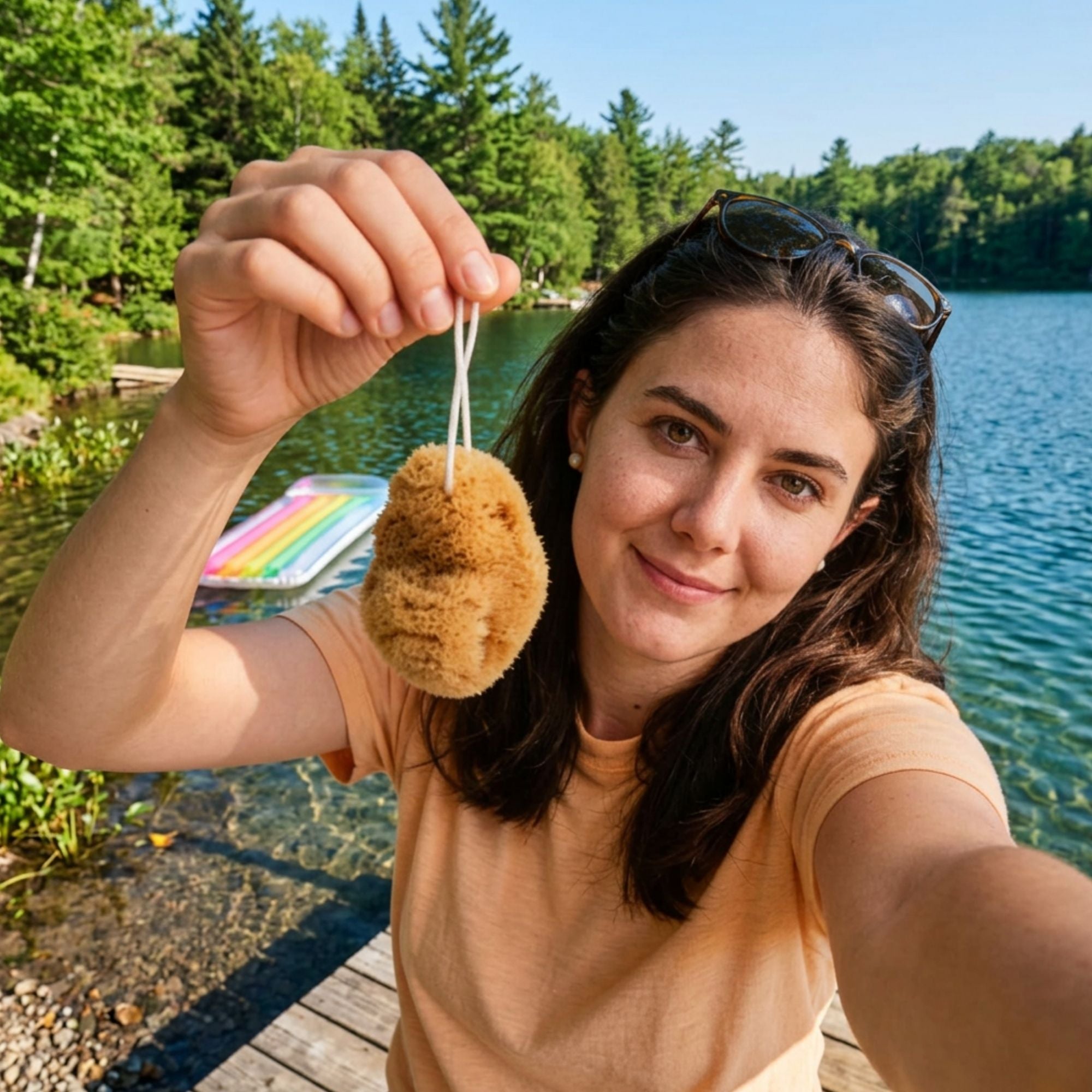
There are several thousand sponge species worldwide. Only a few of them are actually suitable for use on or inside the body. The HERA period sponge is the original tampon, which we have modernized. It is a very specific type of sponge from the eastern Mediterranean. It is soft, fine-pored, and has been used for exactly this purpose for centuries.
Sustainable harvesting: Where the natural sponges come from
The ecological footprint of a period sponge is decided not when it is thrown away, but at the harvest. HERA natural sponges come from a small, third-generation family-run diving business in Greece. They grow there naturally in clear, controlled marine zones and are harvested exclusively by hand, not with nets or machines.
The technique is key: the sponge is not completely removed. The root remains anchored to the rock; the sponge regenerates from there and releases seeds from which new sponges grow.
Additionally, there is the harvest window. They are harvested only from June to September. The rest of the year, more than eight months, the stocks remain untouched and can recover completely.
After the harvest, the sponges undergo several cleaning processes. They are mechanically cleaned, washed in Greece with our own soap, and sorted by hand. Only the softest and finest-pored specimens make it into our range. Further cleaning and packaging are then carried out by the ARWO Foundation in Switzerland, which employs people with disabilities.
The principle behind this is simple: only harvest as much as grows back. Here, sustainability means not only "compostable at the end," but also "responsible from the very beginning."
👉 You can find more about this on our page about the harvest in Greece
👉 Discover our HERA menstruation sponge starter set for an easy switch
What is actually inside conventional period products?
Aside from the waste issue, it is worth taking a look at the product itself. At first glance, tampons consist of cotton or viscose. However, chemical processes are often used in production for bleaching, shaping, or for a synthetic cover intended to make insertion easier.
What exactly is inside remains mostly unclear: manufacturers of period products are not required to fully declare their ingredients. For shampoo, you have to be able to read the fine print. For a product that stays in the body for eight hours, you do not.
A 2024 study by researchers at Columbia University, the UC Berkeley School of Public Health, and Michigan State University detected measurable traces of metals such as lead, cadmium, and arsenic in tested tampons. (Shearston et al., Environment International, 2024)
What we can say is what our customers report back: many report that they feel more comfortable with the period sponge than with tampons—less feeling of dryness, fewer irritations, a more pleasant wearing experience.
The HERA period sponge is simply the easier answer here: 100% natural material, no bleach, no synthetic fibers, no fragrances.
How to switch without it getting complicated
The most common reason a switch fails is not the product—it is the timing. Anyone trying a sponge for the first time on their heaviest day will have an unnecessarily hard time.
How to make it more relaxed:
-
Start on a medium or light day, preferably at home.
-
Clean the sponge with HERA cleaning tabs before (and after your period).
-
Moisten the sponge briefly under warm water, then squeeze slightly and insert gently.
-
To remove, sit down comfortably, press slightly, and pull the silicone retrieval string.
Do's
-
Always work with clean hands.
-
Change at least every 8 hours.
-
Choose the size based on flow and trim if necessary.
-
Rinse in between with clear water or our 2-in-1 soap.
-
Important: always alternate between all three sponges from the set of three. This allows each sponge enough time to dry between uses and ensures all sponges are used evenly.
Don'ts
-
Do not boil and do not put in the washing machine.
-
No vinegar, no baking soda, no home remedy experiments—this damages the structure.
-
Do not store damp in an airtight container.
👉 You can find the detailed instructions on our page about using the period sponge
Conclusion
You don't have to turn your life upside down to significantly reduce your period waste. A single product change is enough: instead of using around 250 disposable items year after year, six natural sponges will get you through a whole year. Because it is compostable, plastic-free, and sustainably harvested.
👉 Discover our HERA menstruation sponge starter set for an easy switch
FAQs
How much waste does the period sponge save compared to tampons?
Instead of around 250 disposable products per year, you need about three to six period sponges. Calculated over 40 years, this is about 240 to 480 compostable sponges instead of around 10,000 disposable items and without applicators, films, and hygiene bags.
Period sponge or menstruation sponge—what is the difference?
None. Both terms refer to the same product: a natural sponge that is used during the period instead of a tampon. "Period sponge" is the more common term in German-speaking countries; "menstruation sponge" is slightly more formal. At HERA, we mostly use "period sponge" because most customers call it that.
Is the period sponge really compostable?
Yes. The sponge is a natural marine organism with no plastic content and can be disposed of in organic waste or on the compost after its useful life. Important: remove the silicone retrieval string beforehand; it does not belong in the compost.
How many tampons does a woman use in her lifetime?
Common estimates are 10,000 to 17,000 tampons and pads over a period-active life of around 40 years. The range is so large because flow intensity, cycle length, and the choice between tampon, pad, and panty liner vary greatly. Mathematically, it is about 250 products per year.
Is a period sponge a coral?
No. A sponge is an independent organism, without a circulatory system and without a nervous system. It grows on the seabed and filters water. During harvest, the root remains in the rock so the sponge can regrow. Corals are not touched during sponge harvesting.
Where do HERA period sponges come from?
From a third-generation family-run diving business in Greece. They are harvested by hand in controlled marine zones, and only from June to September. The rest of the year, the stocks remain untouched. Afterward, the sponges undergo several cleaning steps before being packaged in Switzerland.
Do tampons really contain plastic and chemicals?
Many conventional products contain plastic in the cover, string, or film; pads are actually made of up to 90% plastic. A 2024 study by researchers at Columbia University, UC Berkeley, and Michigan State University also found traces of metals such as lead, cadmium, and arsenic in tested tampons. Manufacturers have not yet been required to fully declare ingredients.